10 Subtle Signs of Gum Disease Most Adults Miss
Posted on 4/6/2026 by Singing River Dentistry - Florence |
 Most adults in Florence, AL who develop gum disease never feel a single sharp warning sign – the earliest stages of periodontal disease tend to whisper, not shout, and that quiet onset is exactly why so many people miss the subtle signs of gum disease until it has already advanced. Healthy gums are firm, pale pink, and tight against the teeth, and they should not bleed when you brush or floss. When something is off, your mouth often tells you in small, almost dismissible ways: a faint pink rinse, breath that returns minutes after brushing, gums that look a shade darker than they used to. Individually each of these is easy to wave off. Together, they paint a picture worth listening to. Most adults in Florence, AL who develop gum disease never feel a single sharp warning sign – the earliest stages of periodontal disease tend to whisper, not shout, and that quiet onset is exactly why so many people miss the subtle signs of gum disease until it has already advanced. Healthy gums are firm, pale pink, and tight against the teeth, and they should not bleed when you brush or floss. When something is off, your mouth often tells you in small, almost dismissible ways: a faint pink rinse, breath that returns minutes after brushing, gums that look a shade darker than they used to. Individually each of these is easy to wave off. Together, they paint a picture worth listening to.
This guide walks through ten genuinely subtle signs of gum disease that adults frequently overlook, explains why each one can matter, and outlines when it makes sense to have a professional evaluation. If you want a broader overview of the condition itself, our team at Singing River Dentistry has detailed information on gum disease and how it progresses available on the site.
On This Page
Why Gum Disease Hides So Easily
The earliest form of gum disease, called gingivitis, produces inflammation without much in the way of obvious symptoms. Your gums are made of soft tissue rich in blood vessels, and when plaque and tartar build up at the gumline, the body responds with low-grade inflammation. That inflammation can simmer for years without producing what most people would think of as a real problem.
The next stage, periodontitis, involves the deeper supporting structures around the teeth: the periodontal ligament and the bone that anchors each tooth in place. Damage at this level tends to be slow and silent. By the time mobility, swelling, or noticeable recession becomes obvious, the disease has often been quietly progressing for some time.
In our experience, most patients who learn they have early gum disease are genuinely surprised because they have not had any discomfort to alert them. The window for catching gum disease early depends almost entirely on noticing the subtle clues during everyday life and at routine dental visits. The good news is that those clues do exist; they are just easy to talk yourself out of.
10 Subtle Signs That Get Overlooked
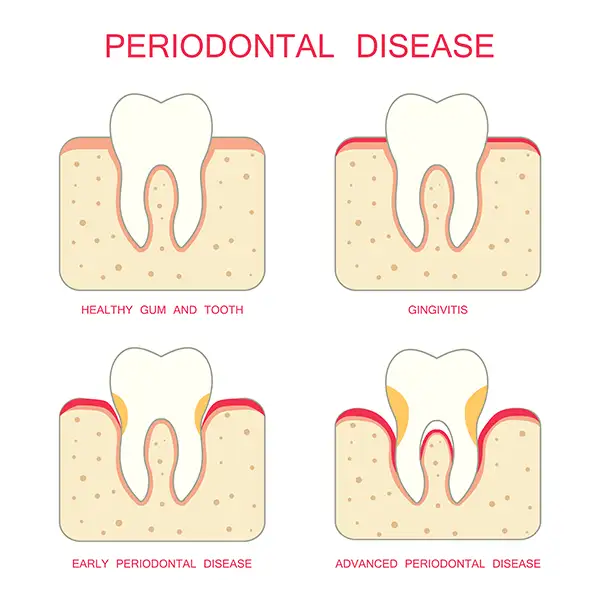 The signs below tend to appear gradually and individually, which is why they so often get filed under “probably nothing.” Read through them with an honest mental check of your own mouth. If two or three feel familiar, that is worth bringing up at your next visit. The signs below tend to appear gradually and individually, which is why they so often get filed under “probably nothing.” Read through them with an honest mental check of your own mouth. If two or three feel familiar, that is worth bringing up at your next visit.
1 and 2: Pink in the Sink and Bad Breath That Won’t Quit
A faint streak of pink when you spit out toothpaste or pull floss away from a tight spot is one of the most common early signs of gingivitis, and it is also one of the most universally ignored. Healthy gums do not bleed when treated gently. Persistent bad breath that does not improve after brushing, flossing, and rinsing is another quiet flag; the bacteria that drive gum inflammation also produce sulfur compounds that mouthwash can mask for a few hours but cannot resolve at the source. If your breath bounces back the same way every morning, it is worth looking at gum health, not just hygiene products. If freshness is a recurring concern, professional bad breath treatment can help identify the underlying cause.
3 and 4: Teeth That Look a Little Longer and Gums That Look a Little Darker
Mild gum recession can be hard to spot in a mirror because it happens millimeter by millimeter. One day you notice that a front tooth seems slightly longer than it used to, or that more of the tooth shows above the gumline than you remember. Recession exposes the root surface, which is softer than enamel and more vulnerable to decay. Color is another visual clue. Healthy gums are pale pink with a stippled, matte texture. Gums that look glossy, swollen, or shifted toward deep red, dusky red, or purple are often inflamed, even when they do not yet feel tender.
5 and 6: Tender Spots and Food That Keeps Catching in the Same Place
Mild tenderness while chewing crunchy foods, such as apples, raw vegetables, or crusty bread, can signal early inflammation in the gum tissue around a specific tooth. The sensation is often vague rather than sharp, and many people stop chewing on that side without giving it much thought. Food packing into the same spot meal after meal is another quiet hint. When gum tissue pulls away from a tooth, even slightly, it creates a small pocket that traps food, which in turn feeds more bacteria and deepens the cycle.
7 and 8: Sensitivity at the Gumline and Small Dark Triangles Between Front Teeth
Cold sensitivity along the gumline, distinct from sharp sensitivity in a specific tooth, often points to exposed root surface from receding gums rather than a cavity. It tends to appear when drinking cold water or breathing in cool air. Small dark spaces forming between the front teeth, especially in the lower jaw, are called black triangles. They develop when the small triangle of gum tissue that normally fills the space between two teeth shrinks back due to chronic inflammation or bone loss. Black triangles are subtle in photos but very common in early-to-moderate periodontal disease.
9 and 10: A Faint Metallic Taste and a Tooth That Feels Different
A persistent metallic or coppery taste, especially in the morning, can come from very small amounts of blood seeping from inflamed gums overnight. It is often dismissed as a sinus issue or a side effect of toothpaste. The last subtle sign is the hardest to articulate: a vague sense that a tooth sits differently than it used to, that your bite has shifted by a hair, or that one tooth feels just slightly looser when you press your tongue against it. Even tiny changes in tooth position or mobility can reflect bone-level changes that deserve a professional look. If any of these signs are noticeable, a thorough dental exam is the most efficient way to find out what is happening.
Why Catching It Early Makes Such a Difference
The single most important fact about gum disease is that the earliest stage, gingivitis, is generally reversible with professional care and consistent home hygiene. At this point the inflammation is confined to the soft tissue, and removing the bacterial buildup that is driving it usually allows the gums to return to a healthy state.
Once gum disease progresses into periodontitis, the picture changes. The damage to bone and connective tissue does not grow back on its own. Treatment at this stage focuses on stopping the progression, controlling the infection, and stabilizing what is still there. Procedures such as scaling and root planing go beneath the gumline to remove deep deposits and smooth the root surfaces so the tissue can reattach as much as possible. Ongoing periodontal maintenance visits then help keep the condition stable over time.
The window between subtle signs and advanced disease is wide, and where you land within it depends largely on early detection. Many of our Florence patients first notice these signs not at a dental visit but at home, in front of the bathroom mirror, which is exactly where this kind of awareness pays off. Noticing them this year can mean a routine cleaning instead of a more involved treatment plan a few years from now.
When to Have It Checked
If two or three of the subtle signs above feel familiar, the most useful next step is a professional evaluation rather than a self-diagnosis. Our team at Singing River Dentistry is happy to take a careful look at your gums, measure pocket depths, and walk through what we find. Florence patients can reach our Hough Road office at 256-764-9955 or get in touch through our home page. Early answers are almost always easier to act on than later ones.
Frequently Asked Questions
Can gum disease really be present without any discomfort?
Yes. Both gingivitis and the early stages of periodontitis are often free of obvious symptoms. Inflammation in the gum tissue does not always produce strong nerve signals, and bone loss happens slowly enough that the body adjusts as it occurs. By the time tenderness or sensitivity is noticeable, the disease has usually been present for a while.
Is bleeding when I floss always a sign of gum disease?
Not always, but it usually is. Healthy gums tolerate gentle flossing without bleeding. Bleeding most commonly indicates inflammation from plaque buildup along or just below the gumline. If bleeding continues for more than a week or two of consistent careful flossing, an evaluation is a good idea.
Can early gum disease be reversed at home?
Improvements in brushing and flossing can reduce inflammation, but tartar that has already hardened along or below the gumline cannot be removed at home. Reversing early gum disease almost always involves a professional cleaning paired with a steady home routine. For more advanced cases, in-office treatment becomes necessary to stop progression.
How often should I have my gums checked?
A periodontal evaluation is typically part of a routine dental exam, which most adults benefit from every six months. If you have already been diagnosed with gum disease, more frequent visits, often every three to four months for periodontal maintenance, may be recommended to keep the condition stable.
What is the difference between gingivitis and periodontitis?
Gingivitis is inflammation limited to the gum tissue and is generally reversible. Periodontitis is a deeper, more advanced form of gum disease that involves loss of the bone and connective tissue around the teeth. Periodontitis can be controlled and stabilized, but the lost bone does not regrow naturally.
|
|